
Thursday, December 15, 2011
Vintage Sexist Ads
Great site, archiving 'vintage' sexism in advertising. Some of them, like the one below, seem, well, unbelievable.


Monday, December 05, 2011
"sisterhood is easier in winter"

Hugo Schwyzer on how miniskirts turn women into bitches.
"policing does tangible damage to women's relationships with other women."
"competitive "bitchiness" towards other women rests on the assumption that men are so unreliable that there's no point in trying to "police" their behavior."
Saturday, June 25, 2011
Male Studies vs. Men's Studies
 The Study of Man (or Males)
By Charles McGrath
The New York Times, January 7, 2011
Since Lionel Tiger is on the side of Male Studies, you know you don't want to be there. Young men are having problems, however. How to square this...?
According to Professor Tiger, the trouble with men’s studies is that it’s “a wholly owned branch of women’s studies.” ...The people in men’s studies, like those in women’s studies, take a mostly sociological perspective and believe that masculinity is essentially a cultural construct and that gender differences in general are fluid and variable... The male studies people, on the other had, are what their critics call “essentialists” and believe that male behavior is in large part biologically determined... Professor Tiger...worries that the changes that have allowed women to control their own reproductive process have unnaturally and disastrously altered the balance of power between the sexes... the male studies movement is less an expansion of that debate than a response to a specific crisis, the nature of which both sides agree on: academically at least, young men are in trouble.
Starting in grammar school, they lag behind girls by most observable measures, and the gap widens through high school and college. If males go to college at all, that is. College enrollment tilts at almost 60-40 in favor of women, and once enrolled, women are more likely than men to do well and to graduate.
There are a lot of explanations for why this is so. A popular theory, set forth in books like “The Trouble With Boys,” by Peg Tyre, and “The War Against Boys: How Misguided Feminism Is Hurting Our Young Men,” by Christina Hoff Sommers, is that grammar school classrooms have become excessively feminized, impatient with boys’ naturally boisterous behavior and short attention spans and inattentive to the way in which boys learn differently from girls...Professor Tiger believes that by the time girls get to college, there is a Darwinian component to the achievement gap: women are aware of the divorce rate and the likelihood that they may raise children without ever marrying in the first place. “They’re studying for two,” he explained. “Guys just don’t have that sense, that inwit. That’s biology at its most essential.”
And then there are the various cultural arguments: that at least by some standards of masculinity, learning — reading and writing especially — is “uncool,” and that college campuses have become inhospitable to men, who now suffer from fragile self-regard. People associated with the male studies movement frequently bring up the date rape seminar now obligatory on most campuses. On their very first day at college, awkward young men are gathered into a room with their female counterparts and, the argument goes, made to feel like sexual predators...
Miles Groth, who teaches psychology at Wagner College and was host of the conference there last spring, says that what he hears all the time from male undergraduates on his campus is “I just don’t feel welcome here”...he has himself established a men’s center at Wagner, a small, private liberal arts school where only 36 percent of the students are men and a quarter of them are recruited athletes on scholarship.
Professor Groth’s courses examine what it means to be a man from the points of view of psychology, anthropology, literature and even movies. “Why the silence?” he said between classes one day. “Why hasn’t our generation been more vocal about what’s happening to our young men?” And then he partly answered his own question: “It’s the continuing myth of male power. If I as a man raise these issues I’m just raising that old specter of male power because I want to keep women under control.”
Guerilla Girls
Divisions in the Guerilla Girls. Jeffrey Toobin in The New Yorker, May 30, 2005.
In October, 2003, on behalf of Guerrilla Girls, Inc., two of the original Girls, “Frida Kahlo” and “Käthe Kollwitz,” filed a federal lawsuit against the on-tour and broadband entities, and against several of their former colleagues, including Gertrude Stein, charging them with, among other things, copyright and trademark infringement and unjust enrichment.
In October, 2003, on behalf of Guerrilla Girls, Inc., two of the original Girls, “Frida Kahlo” and “Käthe Kollwitz,” filed a federal lawsuit against the on-tour and broadband entities, and against several of their former colleagues, including Gertrude Stein, charging them with, among other things, copyright and trademark infringement and unjust enrichment.
Saturday, June 18, 2011
When is a man's bared chest obscene: if he has breasts

Wednesday, June 15, 2011
sexual assault fashion ads
This discussion relating the Dominique Strauss-Kahn case to broader issues of sexual assault, from Feminist Wire, is remarkable in particular for the fashion adverts that it reproduces. Please read the entire piece. But look at these ads! Some pertinent quotes from the article are below each one.


sexual assault is neither an aberration nor an abrupt tear in the social fabric. It is, rather, a routine fact of social life.
Calvin Klein, Dolce & Gabbana, and Relish look pretty hip now, don't they?

in the United States alone, every two minutes somebody is sexually assaulted. Over 90 percent of the victims are girls and women.

One in six women in the United States has been sexually assaulted; 60 percent of rapes are not reported. Almost all perpetrators, about 99 percent, are men.

sexual assault is neither an aberration nor an abrupt tear in the social fabric. It is, rather, a routine fact of social life.
Tuesday, June 14, 2011
Don't look butch in Dubai

Watch out, 'boyat'! (Boyat is the derogatory Arabic term for butch females in the UAE.)
Women who wear men’s watches, douse themselves in male deodorant and wear baggy gents’ clothes are at risk of arrest by undercover police at Dubai’s malls and college campuses.
Read more here.
Slutwalk

Recasting the meaning of "slut." SlutWalk started in Toronto in April, and has migrated to the UK, and beyond.
An article in New Statesman discusses some of the logic behind the event: 'Young women, in particular, are expected to look hot and available at all times, but if we dare to express desires of our own, we are mocked, shamed and threatened with sexual violence, which, apparently, has nothing to do with the men who inflict it and everything to do with the length of skirt we have on...sexually active women deserve protection just as much as those whom polite society considers "pure".'
Can slut, like nigger and queer, be invested with new meanings?
Update, July 2, 2011: Katha Pollitt of The Nation weighs in.
Tuesday, April 26, 2011
Pakistan's Supreme Court rules: Pakistanis can opt for 3rd sex on their identity cards
This decision, reported by BBC News, is really groundbreaking. The video is excellent, and note in particular how Shahzadi recounts that as a young person, s/he realized that s/he wasn't either a boy or a girl. Note that in the West, the normative account of the "transgendered" is that he or she was trapped in the wrong body. Because of the existence of the social grouping and cultural category of the hijra in South Asia, it is possible there to imagine oneself as belonging to a "third" category.
I hope all those Westerners who love to congratulate themselves for the supposed "advanced" position of the West on matters gender and sexual will note that Pakistan has moved way, way beyond "us" in the question of the rights of the transgendered. Can you imagine the impact on the transgendered in the US, if they were stopped by the police, and their "third" status was recognized on the driver's license or the passport?
Here's the full report from BBC--but watch the vid:
(6 April 2011 Last updated at 08:52 ET)
Pakistan has taken the landmark decision to allow transsexuals to have their own gender category on some official documents.
The country's Supreme Court has ruled that those Pakistanis who do not consider themselves to be either male or female should be allowed to choose an alternative sex when they apply for their national identity cards.
(6 April 2011 Last updated at 08:52 ET)
Pakistan has taken the landmark decision to allow transsexuals to have their own gender category on some official documents.
The country's Supreme Court has ruled that those Pakistanis who do not consider themselves to be either male or female should be allowed to choose an alternative sex when they apply for their national identity cards.
Thursday, April 21, 2011
Steven Shaviro on Samuel Delaney's "Times Square Red, Times Square Blue"
I loved this book. Steven Shaviro captures its significance brilliantly in his review. Here's an excerpt:
"I don't think I have ever read any account of sex and sexual encounters (whether truthful or fictional, gay or straight or whatever) that has been so demystified-or perhaps I could better say, so clearheaded and refreshingly down-to-earth. Nothing in Delany's accounts is idealized by utopianism or burnished by nostalgia. But neither does anything ever appear sleazy or depraved (as is so often the case in sensationalistic accounts of sexual 'subcultures' written for outsiders). Delany implicitly rejects our culture's tendency to define sexuality, and especially non-heterosexual and/or non-monogamous sexuality, as being (whether for good or for ill) transgressive. Delany links sexual desire to the multifarious pleasures of the flesh and intellect, rather than seeing it (in the fashion of so many modernist and postmodernist visionaries) as a sort of metaphysical absolute. He is most of all concerned to underline the everydayness of a sex life that included multiple encounters with multiple partners in these venues. The emotional fulfillment and sense of community provided even by the most fleeting of these encounters is (or at least should be) not an extraordinary situation, but a basic experience of everybody's life."
Monday, January 24, 2011
Gay Parenting in the South
"Parenting by Gays More Common in the South, Census Shows" by Sabrina Tavernise, New York Times, January 18, 2010
...as demographers sift through recent data releases from the Census Bureau, they have found that Jacksonville [Florida] is home to one of the biggest populations of gay parents in the country.
In addition, the data show, child rearing among same-sex couples is more common in the South than in any other region of the country, according to Gary Gates, a demographer at the University of California, Los Angeles. Gay couples in Southern states like Arkansas, Louisiana, Mississippi and Texas are more likely to be raising children than their counterparts on the West Coast, in New York and in New England.
The pattern, identified by Mr. Gates, is also notable because the families in this region defy the stereotype of a mainstream gay America that is white, affluent, urban and living in the Northeast or on the West Coast...
Black or Latino gay couples are twice as likely as whites to be raising children, according to Mr. Gates...They are also more likely than their white counterparts to be struggling economically.
Experts offer theories for the pattern. A large number of gay couples, possibly a majority, entered into their current relationship after first having children with partners in heterosexual relationships, Mr. Gates said. That seemed to be the case for many blacks and Latinos in Jacksonville, for whom church disapproval weighed heavily...
About a third of lesbians are parents, and a fifth of gay men are. Advocacy groups argue that their children are some of society’s most vulnerable, with fewer legal protections and less health insurance than children of heterosexual parents.
Even so, their ranks have been mostly left out of national policy debates, because the Census Bureau did not conduct its first preliminary count of same-sex couples until 1990. This year, the bureau will count married same-sex partners for the first time.
Read the entire article here.
A fascinating article. Here are some excerpts:
...as demographers sift through recent data releases from the Census Bureau, they have found that Jacksonville [Florida] is home to one of the biggest populations of gay parents in the country.
In addition, the data show, child rearing among same-sex couples is more common in the South than in any other region of the country, according to Gary Gates, a demographer at the University of California, Los Angeles. Gay couples in Southern states like Arkansas, Louisiana, Mississippi and Texas are more likely to be raising children than their counterparts on the West Coast, in New York and in New England.
The pattern, identified by Mr. Gates, is also notable because the families in this region defy the stereotype of a mainstream gay America that is white, affluent, urban and living in the Northeast or on the West Coast...
Black or Latino gay couples are twice as likely as whites to be raising children, according to Mr. Gates...They are also more likely than their white counterparts to be struggling economically.
Experts offer theories for the pattern. A large number of gay couples, possibly a majority, entered into their current relationship after first having children with partners in heterosexual relationships, Mr. Gates said. That seemed to be the case for many blacks and Latinos in Jacksonville, for whom church disapproval weighed heavily...
About a third of lesbians are parents, and a fifth of gay men are. Advocacy groups argue that their children are some of society’s most vulnerable, with fewer legal protections and less health insurance than children of heterosexual parents.
Even so, their ranks have been mostly left out of national policy debates, because the Census Bureau did not conduct its first preliminary count of same-sex couples until 1990. This year, the bureau will count married same-sex partners for the first time.
Read the entire article here.
Thursday, December 16, 2010
Civil Unions Gaining over Marriage in France
Scott Sayare and Maïa de la Baume, writing in the New York Times, Dec. 15, 2010:
Whatever their reasons, and they vary widely, French couples are increasingly shunning traditional marriages and opting instead for civil unions, to the point that there are now two civil unions for every three marriages...
While the partnerships have exploded in popularity, marriage numbers have continued a long decline in France, as across Europe. Just 250,000 French couples married in 2009, with fewer than four marriages per 1,000 residents; in 1970, almost 400,000 French couples wed.
Germany, too, has seen a similar plunge in marriage rates. In 2009, there were just over four marriages per 1,000 residents compared with more than seven per 1,000 in 1970. In the United States, the current rate is 6.8 per 1,000 residents, according to the Centers for Disease Control and Prevention.
Read the entire article here.
Whatever their reasons, and they vary widely, French couples are increasingly shunning traditional marriages and opting instead for civil unions, to the point that there are now two civil unions for every three marriages...
While the partnerships have exploded in popularity, marriage numbers have continued a long decline in France, as across Europe. Just 250,000 French couples married in 2009, with fewer than four marriages per 1,000 residents; in 1970, almost 400,000 French couples wed.
Germany, too, has seen a similar plunge in marriage rates. In 2009, there were just over four marriages per 1,000 residents compared with more than seven per 1,000 in 1970. In the United States, the current rate is 6.8 per 1,000 residents, according to the Centers for Disease Control and Prevention.
Read the entire article here.
Saturday, December 11, 2010
The boyish look is being replaced by the "manly trend"
 “For a long time it was just those skinny guys, those boyish Prada types,” [Jason Kanner] said, referring to men like Cole Mohr — a model with jug ears and the body of a teenager — long a favorite at labels like Prada and Louis Vuitton. “I hate to use the word waif, but what else can you call all these skinny young hairless guys?”
But now, it's the "real" man type. Jon Hamm and his ilk. Metrosexual look on its way out?
More from Guy Trebay, writing in the New York Times, October 17, 2010.
(Photo by Lee Clower, for the NY Times. Chris Winter, on left, illustrates the boyish look, now seemingly being replaced by the manly look of Doug Porter, on the right.)
Monday, November 15, 2010
Madeleine Bunting debunks the 'science' of sex difference
"The truth about sex difference is that if men are from Mars, so are women" -- The Guardian, Nov. 14, 2010.
Excerpts below:
Type "men" and "hardwired" into Google and you tap into a wonderfully absurd catalogue of assertions about male behaviour. Men are "hardwired" to cheat, ignore their wives, suspect infidelity, overspend, fail, love money, pursue women and achieve supremacy in the workplace. Meanwhile, women are "hardwired" to worry about their weight and dump cheaters. All include the magic phrase "scientific studies show". It's a snapshot of how science is being used and abused to legitimise gender stereotypes. It would be laughable if it didn't signify how a form of biological determinism – the claim that differences between men and women have a basis in innate biological characteristics – has re-emerged and acquired an astonishing popular currency...
What's changed in recent years is that the idea of innate biological differences – for instance in cognitive abilities or communication skills – has gained academic credibility and powerful champions in widely admired researchers such as Simon Baron Cohen (author of The Essential Difference) and Steven Pinker. In their wake has followed this boom in scientific studies claiming to find hardwiring for sex differences, and every time they do so, they are guaranteed to accumulate column inches of free publicity. The argument is that breakthroughs in neuroscience, genetics and evolutionary psychology are proving false the feminist consensus of the last 30-odd years that gender is entirely a social construct. The claim is that there are innate differences, and they go part of the way in explaining why men and women have such different lives.
Nonsense, retort a number of prominent women academics who have been trying to fight back in the US and the UK. A new book, Brainstorm, by Rebecca Jordan-Young exhaustively analyses every relevant study on hormonal sex differentiation of the human brain, and argues that they are riddled with weaknesses, inconsistencies and ambiguity. It's a clarion call for better science on the subject.
Jordan-Young's call is echoed in the UK by Deborah Cameron, an Oxford professor of language and communication. She takes issue with one of the central claims that women have superior verbal abilities; some speculate that this is linked to brain structure, others that it has an evolutionary explanation. Cameron sees both as purely speculative, and insists that explanations of difference must take account of three much more prosaic factors...
[re factor two:] Contrary to the commonplace assumption that women speak more, there is now mountains of evidence, claims Cameron, that where status is not a factor there is no difference between men and women; where status does matter – such as office meetings – men talk much more than women...
Or take another central pillar of the new biological determinism which asserts that men and women have different cognitive capabilities. Professor Elizabeth Spelke has spent her academic career looking at cognitive development in infants, and concludes: "All this research supports the startlingly boring conclusion that there are no significant differences between men and women's cognitive abilities."...
But if the evidence for biologically innate differences is so flimsy and full of conjecture, why does it continue to have such a hold on the imagination – in bestselling self-help books and among brilliant, respected scientists? Cameron suggests that this grasping after certainty about gender roles is a response to anxiety. There has been, and still is, rapid social change around the roles and opportunities of men and women.
Cameron adds that a lot of the debate around differing communication skills seems rooted in a rise in conflict between the sexes...
Spelke adds another intriguing dimension to the sustained popularity of forms of biological determinism. Her most recent research devised tests which showed that children as young as three begin to categorise the world by gender. Work she is doing indicates this could begin to develop even earlier – at 10 months. Interestingly, the same process of categorisation in infants is not evident when it comes to race. "We are predisposed to see the social landscape in terms of gender," says Spelke.
She thinks it's possible that it served some adaptive purpose in our evolution, but that actually gender is a very bad indicator of behaviour because there is so much variability within each sex...
Good science will challenge the tendency to stereotype. The danger though is what Cameron refers to as "stereotype threat". If you tell women that women do less well in a maths test, they will do less well, confirming the claim. Don't tell them, and they do better. Stereotypes are dangerous; they become self-fulfilling and can generate discrimination. Cameron points to interviews with call-centre managers who were discriminating against hiring men on their assumption that women were better at empathising. So beware a popular mythology of hardwiring that can result in some very concrete – and pernicious – outcomes.
Excerpts below:
Type "men" and "hardwired" into Google and you tap into a wonderfully absurd catalogue of assertions about male behaviour. Men are "hardwired" to cheat, ignore their wives, suspect infidelity, overspend, fail, love money, pursue women and achieve supremacy in the workplace. Meanwhile, women are "hardwired" to worry about their weight and dump cheaters. All include the magic phrase "scientific studies show". It's a snapshot of how science is being used and abused to legitimise gender stereotypes. It would be laughable if it didn't signify how a form of biological determinism – the claim that differences between men and women have a basis in innate biological characteristics – has re-emerged and acquired an astonishing popular currency...
What's changed in recent years is that the idea of innate biological differences – for instance in cognitive abilities or communication skills – has gained academic credibility and powerful champions in widely admired researchers such as Simon Baron Cohen (author of The Essential Difference) and Steven Pinker. In their wake has followed this boom in scientific studies claiming to find hardwiring for sex differences, and every time they do so, they are guaranteed to accumulate column inches of free publicity. The argument is that breakthroughs in neuroscience, genetics and evolutionary psychology are proving false the feminist consensus of the last 30-odd years that gender is entirely a social construct. The claim is that there are innate differences, and they go part of the way in explaining why men and women have such different lives.
Nonsense, retort a number of prominent women academics who have been trying to fight back in the US and the UK. A new book, Brainstorm, by Rebecca Jordan-Young exhaustively analyses every relevant study on hormonal sex differentiation of the human brain, and argues that they are riddled with weaknesses, inconsistencies and ambiguity. It's a clarion call for better science on the subject.
Jordan-Young's call is echoed in the UK by Deborah Cameron, an Oxford professor of language and communication. She takes issue with one of the central claims that women have superior verbal abilities; some speculate that this is linked to brain structure, others that it has an evolutionary explanation. Cameron sees both as purely speculative, and insists that explanations of difference must take account of three much more prosaic factors...
[re factor two:] Contrary to the commonplace assumption that women speak more, there is now mountains of evidence, claims Cameron, that where status is not a factor there is no difference between men and women; where status does matter – such as office meetings – men talk much more than women...
Or take another central pillar of the new biological determinism which asserts that men and women have different cognitive capabilities. Professor Elizabeth Spelke has spent her academic career looking at cognitive development in infants, and concludes: "All this research supports the startlingly boring conclusion that there are no significant differences between men and women's cognitive abilities."...
But if the evidence for biologically innate differences is so flimsy and full of conjecture, why does it continue to have such a hold on the imagination – in bestselling self-help books and among brilliant, respected scientists? Cameron suggests that this grasping after certainty about gender roles is a response to anxiety. There has been, and still is, rapid social change around the roles and opportunities of men and women.
Cameron adds that a lot of the debate around differing communication skills seems rooted in a rise in conflict between the sexes...
Spelke adds another intriguing dimension to the sustained popularity of forms of biological determinism. Her most recent research devised tests which showed that children as young as three begin to categorise the world by gender. Work she is doing indicates this could begin to develop even earlier – at 10 months. Interestingly, the same process of categorisation in infants is not evident when it comes to race. "We are predisposed to see the social landscape in terms of gender," says Spelke.
She thinks it's possible that it served some adaptive purpose in our evolution, but that actually gender is a very bad indicator of behaviour because there is so much variability within each sex...
Good science will challenge the tendency to stereotype. The danger though is what Cameron refers to as "stereotype threat". If you tell women that women do less well in a maths test, they will do less well, confirming the claim. Don't tell them, and they do better. Stereotypes are dangerous; they become self-fulfilling and can generate discrimination. Cameron points to interviews with call-centre managers who were discriminating against hiring men on their assumption that women were better at empathising. So beware a popular mythology of hardwiring that can result in some very concrete – and pernicious – outcomes.
Sunday, November 14, 2010
empathetic genes; survival of the kindest
Essential reading. I'm skeptical that "empathy" is found in one gene, but broadly sympathetic to the thrust of this developing domain of research.
As for college-goers, UC Berkeley psychologist Rodolfo Mendoza-Denton has found that cross-racial and cross-ethnic friendships can improve the social and academic experience on campuses. In one set of findings, published in the Journal of Personality and Social Psychology, he found that the cortisol levels of both white and Latino students dropped as they got to know each over a series of one-on-one get-togethers. Cortisol is a hormone triggered by stress and anxiety.
And much more...
As for college-goers, UC Berkeley psychologist Rodolfo Mendoza-Denton has found that cross-racial and cross-ethnic friendships can improve the social and academic experience on campuses. In one set of findings, published in the Journal of Personality and Social Psychology, he found that the cortisol levels of both white and Latino students dropped as they got to know each over a series of one-on-one get-togethers. Cortisol is a hormone triggered by stress and anxiety.
And much more...
Friday, November 12, 2010
Erica Jong on "attachment mothering"
Brilliant! From the Wall Street Journal, Nov. 6, 2010. Full article here.
We also assume that "mother" and "father" are exclusive terms, though in other cultures, these terms are applied to a variety of aunts, uncles and other adults. Kinship is not exclusively biological, after all, and you need a brood to raise a brood. Cooperative child-rearing is obviously convenient, but some anthropologists believe that it also serves another more important function: Multiple caregivers enhance the cognitive skills of babies and young children. Any family in which there are parents, grandparents, nannies and other concerned adults understands how readily children adapt to different caregivers. Surely this prepares them better for life than stressed-out biological parents alone.

We also assume that "mother" and "father" are exclusive terms, though in other cultures, these terms are applied to a variety of aunts, uncles and other adults. Kinship is not exclusively biological, after all, and you need a brood to raise a brood. Cooperative child-rearing is obviously convenient, but some anthropologists believe that it also serves another more important function: Multiple caregivers enhance the cognitive skills of babies and young children. Any family in which there are parents, grandparents, nannies and other concerned adults understands how readily children adapt to different caregivers. Surely this prepares them better for life than stressed-out biological parents alone.
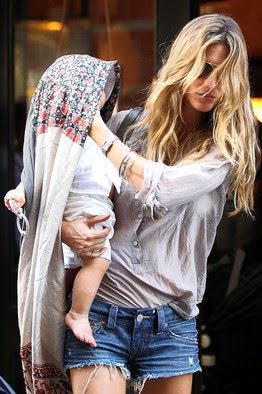
Baby as accessory: Gisele Bündchen with baby Benjamin (Getty Images)
Thursday, October 07, 2010
"Love Supreme: Gay Nuptials and the Making of Modern Marriage"
 Adam Haslett, writing in The New Yorker, May 31, 2004. An excellent account of the debate, the issues, and the modern institution of marriage, to date.
According to the 2000 census, the first to collect such data, there are five hundred and ninety-four thousand same-sex couples living in the United States (and that’s no doubt an undercount, given people’s reluctance to report their sexual orientation to the government). But marriage requires the consent of a third party—namely, the state.
Thursday, September 16, 2010
Adolescent boys and cosmetic breast surgery
 Shocking article by Alex Kuczynski, New York Times, June 14, 2007.
In 2006, according to the [American Society of Plastic Surgeons], nearly 14,000 boys age 13 to 19 underwent surgery to reduce the size of their breasts. That represents 70 percent of all the male patients who had such surgery last year, and an increase of 21 percent over the previous year for that age group...
In a culture that increasingly encourages young boys to be body conscious, demand for chiseled torsos and sculpted pecs is rising, so much so that the number of boys ages 13 to 19 who had breast reduction surgery last year is equal to the total number of all men who had the procedure just two years earlier, in 2004.
The foremost reason is the rise in obesity, according to several plastic surgeons who were interviewed...
Often, enlarged breasts are simply part of adolescence, most commonly caused by the hormonal fluctuation of puberty, according to the National Institutes of Health...
in most adolescents who are not obese, the condition will resolve itself spontaneously as the boy progresses through adolescence and produces more testosterone, said Dr. Brenda Kohn, an associate professor of pediatrics who specializes in pediatric endocrinology at New York University School of Medicine.
As such, she said, “It is very important that one not operate on a child who is still in puberty.”
(emphasis added)
"Teaching Japan's Salarymen to Be Their Own Men"
 Informative article by Howard W. French, The New York Times, Nov. 27, 2002. Excerpts below:
Not so long ago it was acceptable, even cool, here to introduce oneself as an ''average salaryman.'' The expression conjured images of the total company man -- someone who leaves work each day only to stay out late drinking and talking shop with colleagues, and whose first three words to his devoted wife upon arrival home were likely to be bath, meal, bed. As in, get them ready.
But those were the days of Japan's world-beating economy, when many women dreamed of nothing more than raising a family with a man with a lifetime job. During 12 years of flat growth, women have stampeded out of the kitchen and into the workplace. Now, as women have come to enjoy greater freedoms, there are suddenly few things less hip in Japan than to be an oyaji, or typical middle-aged man.
Like many social phenomena in Japan, the collapsing status of the corporate warrior has generated its own vocabulary. For younger women, the dark-suited company men seen everywhere walking two or three abreast, chain-smoking, their heads slightly bowed, are dasai (uncool) or nasakenai (clueless). For the wives to whom many of them return home in the evening, meanwhile, they are the nure-ochiba zoku (the wet leaf tribe) -- clingy, musty and emotionally spent.
Mr. [Masayoshi] Toyoda, who has built a national network of men's liberation groups, is anything but nostalgic. What he yearns for is the reinvention of the Japanese man, not a return to the strong-and-silent types on whose backs Japan's fantastic post-World War II success supposedly was constructed. Indeed, rebellion against the old model is what turned him on to liberation in the first place...
Unlike their American counterparts, who often invoke religion or mythology, members of Japan's budding men's movement do not gather in the woods to beat drums or sit in circles to hug or cry...
What many of them do share with their Western counterparts is a feeling that men must find a way to be both vigorous and sensitive. This starts by rediscovering life outside the workplace, sharing time with their families and, above all, learning -- often for the first time -- how to communicate personal thoughts...
One of Mr. Toyoda's priorities is lobbying companies and governments and sensitizing men about paternal leave. While almost all men are eligible, less than 1 percent of male employees presently use the benefit.
Saturday, February 20, 2010
Metrosexual Tweens
The metrosexual revolution is taking hold, among tween boys.
"Masculinity in a Spray Can," Jan Hoffman, New York Times, Sunday Styles, Jan. 31, 2010.
My understanding of metrosexuality is that, in part, it is an effort to get men to purchase as many grooming products as men do currently. Huge profits are at stake. This article seems to indicate that the marketeers have done their job.
Body wash. Face wash. Exfoliator. Exfoliating wash. Body hydrator. Body spray. Deodorant. Shaving cream. Shampoos and conditioner. Hair gel, of course...
many psychologists, parents, market researchers and middle-school principals (with drawers full of confiscated spray cans), report a sharp surge in the last few years of the use of grooming products by tween boys. In a December 2007 report on teenage and tween grooming products, Packaged Facts, a market research firm, projected that worldwide retail sales for boys ages 8 to 19 would be almost $1.9 billion...
Boys themselves, at a younger age, have also become increasingly self-conscious about their appearance and identity...
“More insecurity equals more product need, equals more opportunity for marketers,” said Kit Yarrow, a professor of psychology and marketing at Golden Gate University...
To engage boys, marketers rely less on 30-second TV spots than on interactive Web sites, creating communities of young fans...
What further drives the boys’ rush to the products are girls themselves. Marshal Cohen, chief industry analyst for the market research firm NPD Group, said that in a recent survey, 41 percent of boys ages 8 to 18 said that one of their best friends was a girl.
“They shop with girls, and girls influence them,” Mr. Cohen said, much as the girls in the hit Nickelodeon tween show “iCarly” hold sway over Freddie, their hapless male buddy...
“Boys are paying attention to personal brands more than ever because it’s too easy to be criticized virally by a girl,” said Pat Fiore, a market consultant for body image products in Morristown, N.J...
With consumer researchers pumping out reports on strategies to attract tween boys — make them feel accepted by peers, yet make them feel like cool individuals — and the success, over all, of the expanding, multibillion dollar male grooming products industry, the market is hardly saturated.
My understanding of metrosexuality is that, in part, it is an effort to get men to purchase as many grooming products as men do currently. Huge profits are at stake. This article seems to indicate that the marketeers have done their job.
Body wash. Face wash. Exfoliator. Exfoliating wash. Body hydrator. Body spray. Deodorant. Shaving cream. Shampoos and conditioner. Hair gel, of course...
many psychologists, parents, market researchers and middle-school principals (with drawers full of confiscated spray cans), report a sharp surge in the last few years of the use of grooming products by tween boys. In a December 2007 report on teenage and tween grooming products, Packaged Facts, a market research firm, projected that worldwide retail sales for boys ages 8 to 19 would be almost $1.9 billion...
Boys themselves, at a younger age, have also become increasingly self-conscious about their appearance and identity...
“More insecurity equals more product need, equals more opportunity for marketers,” said Kit Yarrow, a professor of psychology and marketing at Golden Gate University...
To engage boys, marketers rely less on 30-second TV spots than on interactive Web sites, creating communities of young fans...
What further drives the boys’ rush to the products are girls themselves. Marshal Cohen, chief industry analyst for the market research firm NPD Group, said that in a recent survey, 41 percent of boys ages 8 to 18 said that one of their best friends was a girl.
“They shop with girls, and girls influence them,” Mr. Cohen said, much as the girls in the hit Nickelodeon tween show “iCarly” hold sway over Freddie, their hapless male buddy...
“Boys are paying attention to personal brands more than ever because it’s too easy to be criticized virally by a girl,” said Pat Fiore, a market consultant for body image products in Morristown, N.J...
With consumer researchers pumping out reports on strategies to attract tween boys — make them feel accepted by peers, yet make them feel like cool individuals — and the success, over all, of the expanding, multibillion dollar male grooming products industry, the market is hardly saturated.
Subscribe to:
Posts (Atom)
